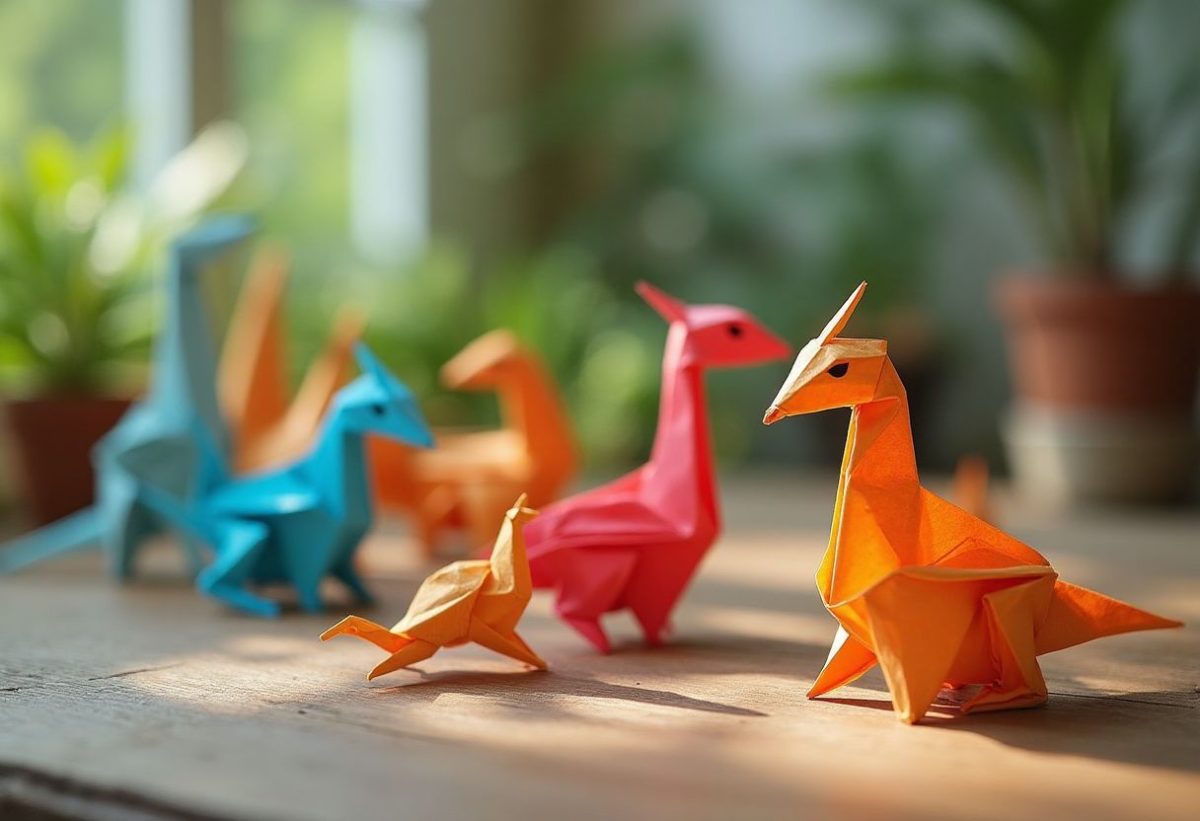
Origami, this centuries-old art of paper folding originating from Japan, has evolved over time to become a rich and varied discipline. Among the many facets of this fascinating art, 3D origami stands out for its ability to give a new dimension to creations. When this art focuses on animals, it reaches peaks of creativity and realism, allowing for the creation of paper sculptures that are as beautiful as they are surprising. Enthusiasts and novices alike discover in this practice a unique means of artistic expression, combining precision, patience, and imagination.
The Origins and Evolution of 3D Origami
Traditional origami has long been the cornerstone of the art of paper folding. However, the evolution towards 3D origami has brought a new perspective, transforming flat sheets into three-dimensional sculptures.
Initially, the art of paper folding focused on simple and symbolic shapes. Practitioners of 3D origami quickly explored modern techniques to push the limits of imagination. By employing complex folds and interlocking modules, they paved the way for the creation of paper animals with stunning details. This art, which requires mastery of shapes and artistic sensitivity, has developed thanks to iconic figures like Akira Yoshizawa and Robert J. Lang, whose contributions have profoundly marked this discipline. Their works have inspired artists around the world to explore the possibilities offered by animal figures in 3D origami.
Techniques and Materials Used in 3D Origami
To create animals in 3D origami, it is essential to understand the techniques and materials suited to this practice. This section highlights the tools and methods that bring paper creatures to life.
- Modular folding: an essential technique where many identical modules are assembled to form a complex structure.
- Special paper: using sturdy and colorful papers, such as kraft paper or special origami paper, is recommended to ensure the durability of the sculptures.
- Precision tools: artists often use marking and cutting tools to achieve clean and precise folds.
By combining these elements, creators can design a variety of animal models, ranging from delicate birds to more complex figures like dragons. 3D origami animals is an artistic expression that relies on a perfect harmony between technique and material choice.
The Most Popular Animals in 3D Origami
Some 3D origami animal models have stood out for their popularity and beauty. Artists from around the world have been captivated by these iconic figures.
Among the most admired creations, the majestic swan often appears, symbolizing grace and elegance. The crane, a classic figure, is often made for its simplicity and visual impact. The dragon, although more complex, represents a challenge that many enjoy taking on for the splendor it offers once completed. Finally, the peacock, with its elaborate tail, presents itself as a work of art in itself, requiring perfect mastery of modular folding. Each of these figures brings its share of challenges and satisfactions, enriching the experience of 3D origami.
The Benefits of Practicing 3D Origami
Beyond the artistic aspect, practicing 3D origami offers numerous benefits, both personally and communally.
- Development of concentration: by focusing on precise folding techniques, practitioners improve their attention and patience.
- Expression of creativity: each creation is an opportunity to express one’s personal style and to take ownership of the forms of nature.
- Strengthening social bonds: participating in workshops or origami communities allows for sharing experiences and building connections around a common passion.
These aspects make 3D origami a rewarding and fulfilling activity that goes far beyond the simple creation of paper animals.
By exploring the art of origami, one discovers a discipline rich in discoveries and emotions. Each fold, each figure, is a creative adventure that brings us a little closer to the beauty of nature.