
You receive the chimney sweep’s invoice, file it with your other tax documents, and then, when it’s time to fill out your tax return, the question comes up: can you claim anything back? The short answer is no for the vast majority of households. The energy transition tax credit (CITE), which covered certain heating-related work, was discontinued in 2021. Since then, neither MaPrimeRénov’ nor any other tax scheme has covered chimney sweeping for owner-occupiers.
Mechanical chimney sweeping and appliance maintenance: two services, two invoices
When you hire a professional to work on your fireplace, you may receive a single invoice with a general description such as “maintenance.” In practice, this often covers two separate services that are treated differently under the regulations.
Mechanical flue sweeping involves scraping and brushing the inside of the flue to remove accumulated soot and creosote. This is the service for which a chimney-sweeping certificate is issued—the document insurers require in the event of a claim.
Maintenance of the heating appliance (stove, insert, or wood-burning boiler) concerns the equipment itself: checking for leaks, inspecting the seals, and cleaning the firebox. A basic maintenance visit is sometimes presented as a full chimney sweep, which can cause problems when you need to provide valid proof of the work.
To find out whether chimney sweeping is tax-deductible, first check that the invoice clearly describes mechanical flue sweeping rather than a simple appliance inspection. This distinction directly affects which expenses a landlord can claim as deductible costs.

Deducting expenses from rental income: the only tax break for chimney sweeping
Owner-occupiers cannot deduct anything. There is no tax credit, no tax reduction, and no box to tick on the tax return. The CITE was replaced by MaPrimeRénov’, which funds major energy-efficiency renovation work (insulation, heating system replacement), but never routine maintenance.
Landlords using the actual-expenses regime
Only landlords who declare rental income under the actual-expenses regime can deduct chimney-sweeping costs. The process is straightforward: maintenance and repair expenses paid by the landlord during the tax year are deducted from the rent received. Chimney sweeping falls into this category, just like descaling a water heater or servicing a mechanical ventilation system.
Under the micro-foncier regime (flat-rate allowance), expenses cannot be deducted individually. The allowance is intended to cover all costs, including chimney sweeping. In this case, there is no tax-return-related reason to keep the invoices, although they should still be kept for insurance purposes.
What is and isn’t deductible
- Mechanical flue sweeping carried out by a qualified professional is a deductible maintenance expense under the actual-expenses regime.
- Completely replacing a chimney flue is considered improvement or construction work, with different tax treatment depending on the circumstances.
- Lining an existing flue to bring it up to code may be considered a maintenance expense if the flue was already in place, but when the amount is significant, it’s worth seeking tax advice to determine whether it counts as improvement work.
Who pays for chimney sweeping: landlord or tenant?
Chimney sweeping is one of the costs that can be passed on to the tenant. In practice, the tenant usually pays for and arranges the work under most residential leases. The landlord, however, remains responsible for providing a flue in good condition at the start of the tenancy.
This is where the tax confusion arises: if the tenant pays, the landlord has nothing to deduct because they haven’t paid anything. The deduction only applies when the landlord covers the cost—for example, between tenancies, while the property is vacant, or when the lease stipulates that the landlord is responsible for flue maintenance.
The chimney-sweeping certificate: proof of work and tax documentation
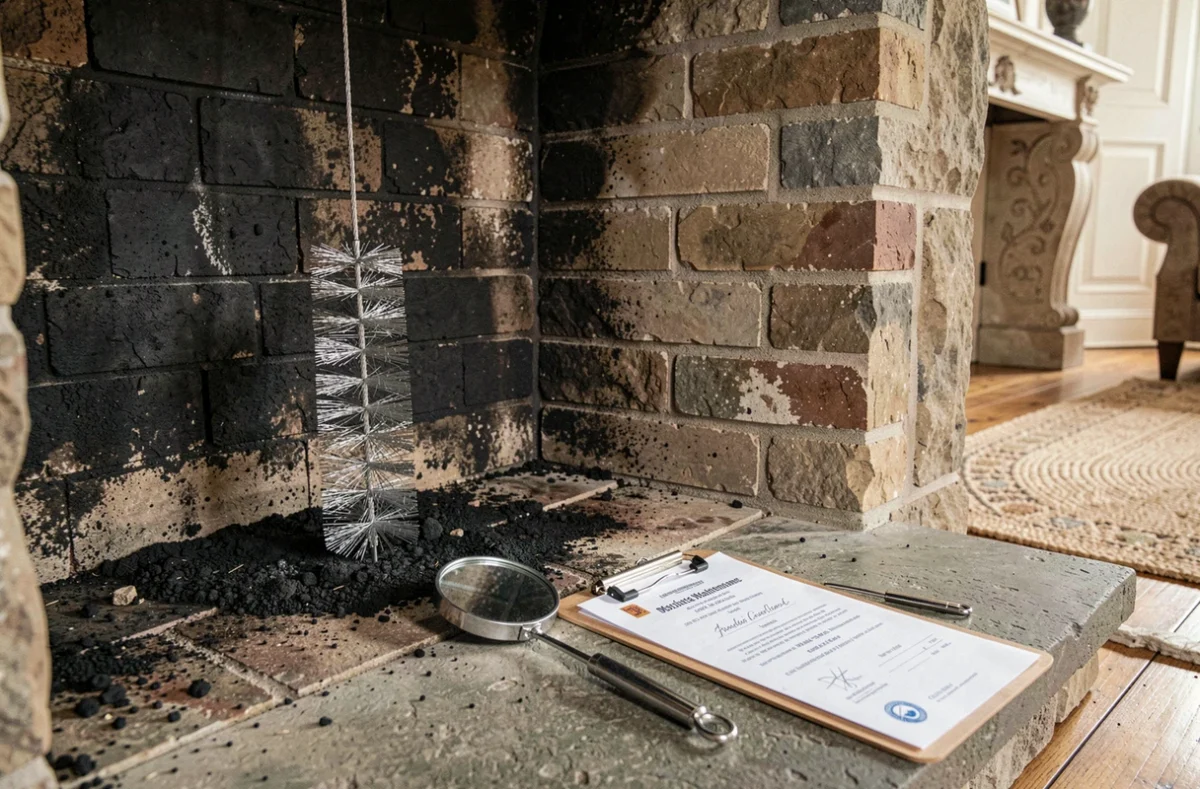
Keeping the chimney-sweeping certificate is useful both for insurance and for your tax return. Issued by the professional after each visit, this document states the date, address, type of flue, and work carried out.
For a landlord using the actual-expenses regime, a paid invoice is generally sufficient to support the deduction. The chimney-sweeping certificate provides additional proof that the service involved mechanical flue sweeping rather than a simple visual inspection. Keeping both documents avoids any disputes in the event of a tax audit.
Legal chimney-sweeping frequency: national rules and local exceptions
Since October 1, 2023, combustion heating appliances must be serviced at least once a year throughout the country. This national standard sets a minimum, not a maximum.
Departmental health regulations and certain municipal orders may still require more frequent sweeping. In several departments, two sweeps a year are still required for flues serving wood- or coal-burning appliances, including one during the heating season.
For landlords, every sweep carried out in accordance with local regulations generates a deductible invoice. Checking the rules that apply in the municipality where the rental property is located helps you plan and budget for the number of visits to declare.
Summary by tax situation
| Situation | Deduction available | Document to keep |
|---|---|---|
| Owner-occupier | No | Certificate (insurance) |
| Landlord under the micro-foncier regime | No (included in the allowance) | Certificate (insurance) |
| Landlord under the actual-expenses regime | Yes, as a maintenance expense | Invoice + certificate |
| Tenant | No | Certificate (insurance + security deposit return) |
Chimney sweeping is a modest expense compared with the annual budget for a rental property. But across several properties and multiple years, deducting it under the actual-expenses regime directly reduces taxable rental income. In all other cases, the invoice serves only as proof that you have met the legal requirement and as protection in the event of an insurance claim.